
Dr. Sumit Shah | Rectal Cancer Specialist in Pune
Rectal Cancer Surgery in Pune
Rectal cancer surgery, sphincter preservation, radiation and drug treatment planned together by one team under Dr. Sumit Shah, Surgical Oncologist.
15+ Years | 2000+ Cancer Surgeries | Baner & Market Yard

Overview
What is rectal cancer? Where does it start?
Rectal cancer starts in the rectum, the last 12 to 15 cm of the large bowel, just before the anus. Most rectal cancers begin as a small growth called a polyp on the inner lining. Over time, some polyps can turn cancerous. For rectal cancer treatment in Pune, Dr. Sumit Shah at Prolife Cancer Centre is a surgical oncologist who can provide evaluation and care.
The rectum sits deep in the pelvis, close to the anal sphincter, bladder, nerves and, in women, the uterus and vagina. How the operation is planned therefore matters for bowel control, urinary function and sexual function. Surgery, radiation and drug therapy are best planned together. Rectal cancer found early is often easier to treat, so bleeding or bowel changes that do not settle should be examined.

Send Us an Enquiry
All fields are mandatory. On submit, WhatsApp opens with your details ready to send to our team.
Why Prolife
Our mission
Eliminate fear of cancer from people's mind and make them realize that cancer is a curable disease.
Rectal Cancer Surgery & Recovery
Symptoms & Risks
Have you noticed any of these changes?
See a doctor if any of these last more than two to three weeks:
- Blood in the stool or bleeding from the back passage
- A change in bowel habits: new constipation, loose stools or going more often
- Feeling the bowel has not emptied fully, or a constant urge to go
- Narrow or pencil-thin stools
- Mucus in the stool
- Pain or a lump in the back passage or lower abdomen
- Unexplained weight loss, tiredness or anaemia
These signs do not always mean cancer. Piles are far more common, but bleeding should not be assumed to be piles without an examination. If even one does not settle, call to arrange a rectal cancer evaluation promptly.
Call Now to Book a Rectal EvaluationWhat increases the risk of rectal cancer?
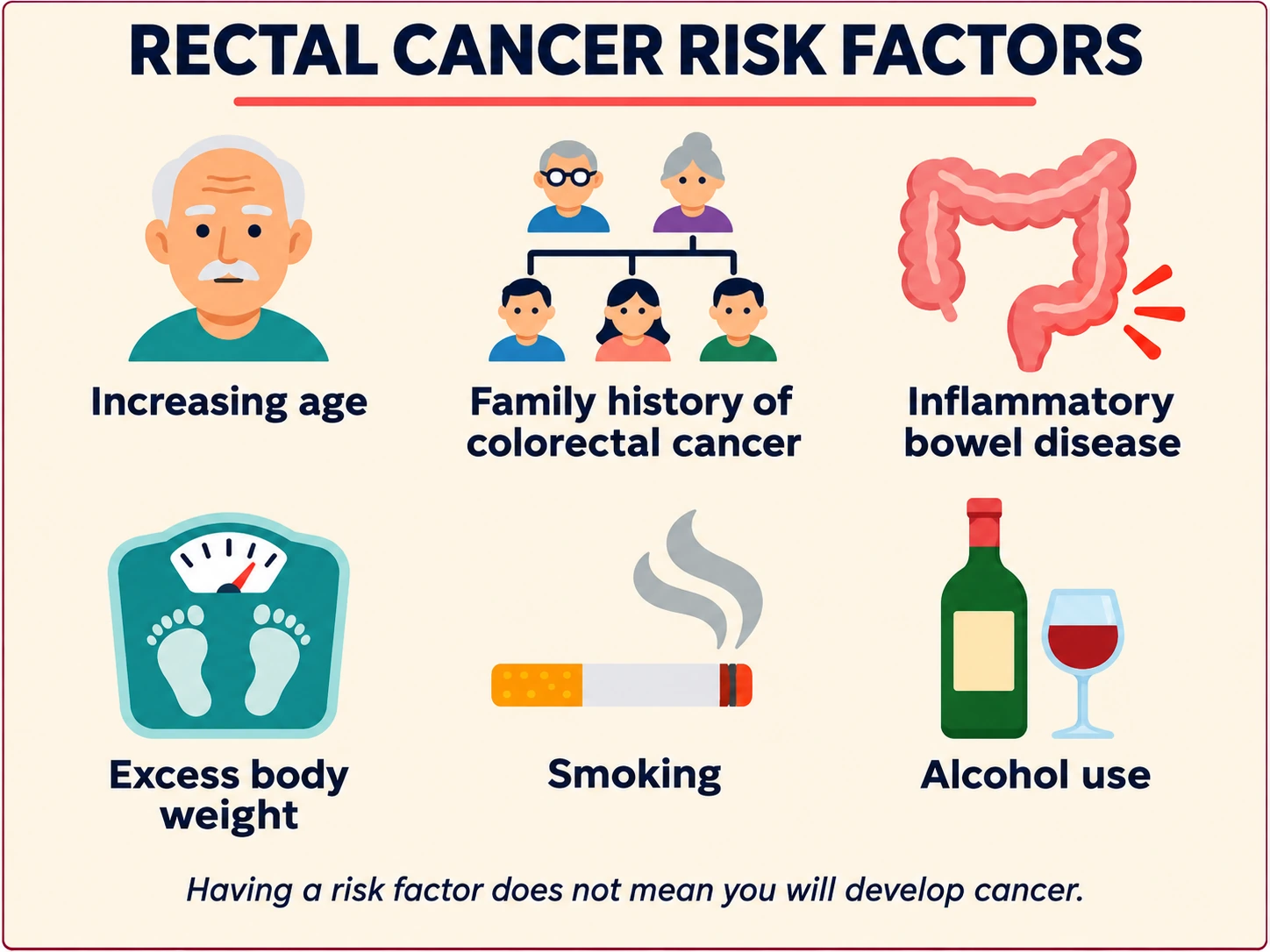
Risk can be lowered. Regular screening such as colonoscopy, as advised by your doctor, finds and removes polyps before they turn into cancer. See Colorectal Cancer Prevention and Screening.
How We Treat Rectal Cancer
- Meet the doctor and check what's neededBring any scans or reports. We examine you, including a rectal examination, and explain whether you need a colonoscopy with biopsy, pelvic MRI or CT scan.
- Plan your treatment togetherRectal cancer is often treated in stages. We discuss whether radiation or chemotherapy should come before surgery, whether the sphincter can be saved, and whether robotic surgery suits you.
- Surgery, then decide on further treatmentThe tumour report after surgery helps decide whether you need more chemotherapy or follow-up. We explain the order of treatment and where each part takes place.
Our Rectal Cancer Team
Dr. Sumit Shah
Surgical Oncologist. DNB Surgical Oncology, Fellowship in Laparoscopic and Robotic Surgery.

Dr. Rupesh Lunkad
Rectal Cancer Surgery
Surgery by Dr. Sumit Shah follows three principles: remove the cancer completely with clear margins, protect the sphincter and pelvic nerves wherever it is safe, and restore function. The operation depends on how far the tumour is from the anus and how deeply it has grown. Robotic surgery is offered in selected cases.
Diagnosis & Stages
How is rectal cancer diagnosed?
Your doctor takes your history and performs a rectal examination. Further tests depend on what is found.
- Colonoscopy with biopsy: a flexible camera examines the bowel and a small piece of the growth is taken to confirm cancer.
- MRI of the pelvis: shows tumour depth, how close it is to the sphincter and nearby organs, and pelvic lymph nodes. It guides the surgery and whether treatment starts before it.
- CT scan of chest and abdomen: checks for spread to the liver, lungs or other organs.
- Blood tests, including CEA: a baseline marker used to monitor treatment.
- Genetic and tumour testing: may be advised for some patients, for example to check for Lynch syndrome.
- PET-CT: only when spread is suspected and other scans are unclear.
Not every patient needs every test. Your surgeon decides what you need for your stage.
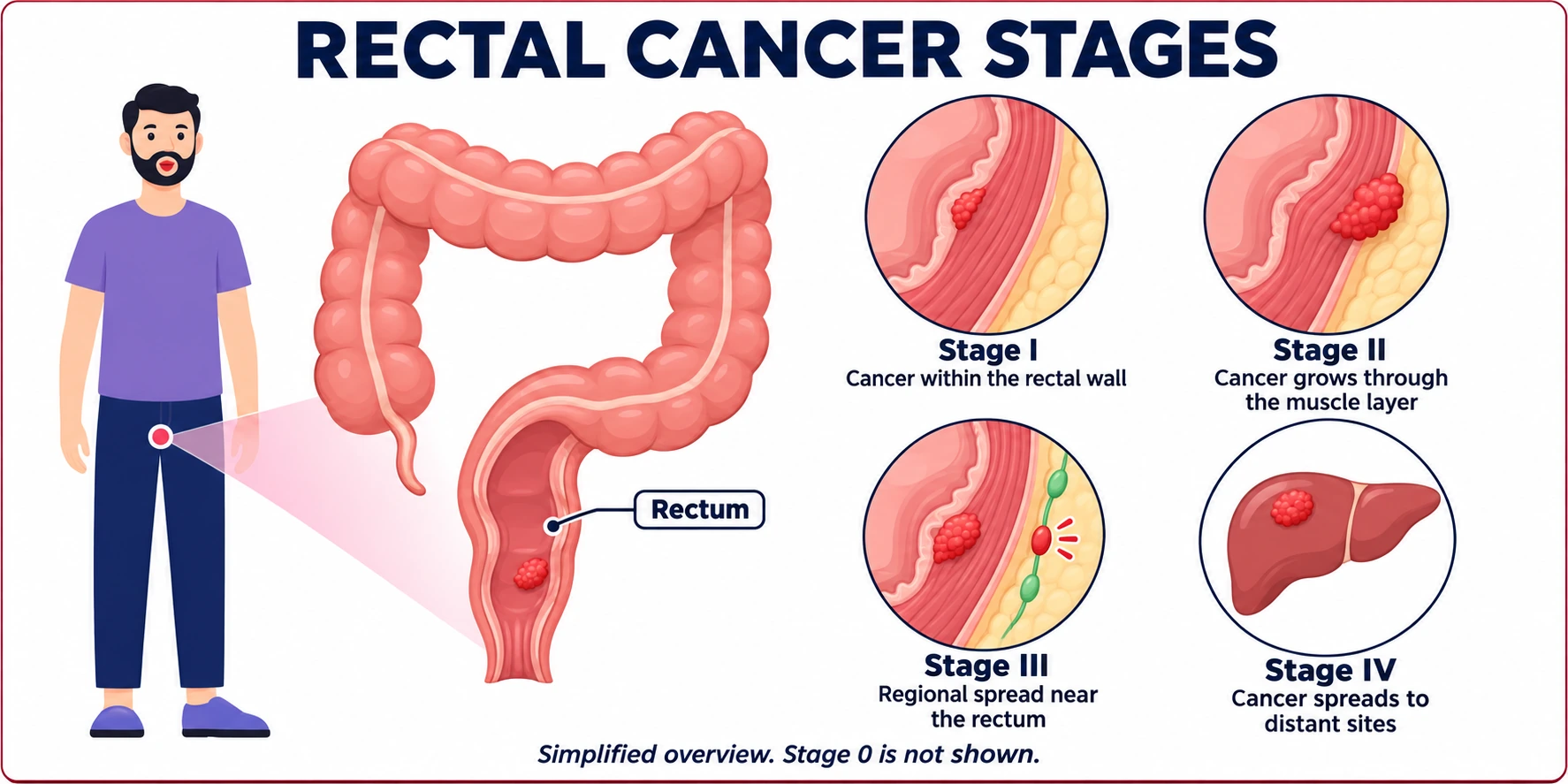
What are the stages of rectal cancer?
Stage tells doctors how deeply the cancer has grown into the bowel wall and whether it has spread.
Reconstruction After Rectal Cancer Surgery
Reconstruction is planned alongside cancer treatment, to help wounds heal and to restore function and comfort where possible.
Rejoining the bowel
After resection, the colon is joined to the remaining rectum or anal canal. A temporary stoma may protect the join, and a later, smaller operation closes it.
Stoma planning
If a stoma is needed, its position is marked before surgery and you are taught how to manage it.
Perineal reconstruction
After abdomino-perineal resection or pelvic exenteration, tissue from nearby areas can be used to close the large perineal wound and support healing.
Radiation Oncology
Radiation for rectal cancer is planned by our radiation oncology team. It is often given before surgery, sometimes together with chemotherapy, to shrink the tumour and lower the chance of the cancer returning in the pelvis. Your team will explain the schedule and what to expect.
Medical Oncology
Our medical oncology team guides chemotherapy, immunotherapy and targeted therapy for rectal cancer, when these are advised for your stage and tumour testing.
Cost Transparency & Insurance Available
Our Insurance & TPA desk guides you through billing and claims, so you can stay focused on treatment. Cost depends on stage, the surgery needed, hospital stay and any added therapy. Read the full details on our Billing & Insurance page.
Documents you will need
- Cashless card, or policy paper (current and previous year)
- PAN card or Aadhaar card showing date of birth
- Doctor's prescription and recent diagnostic reports
Empanelled with leading insurers and TPAs, including: Bajaj Allianz, HDFC ERGO, SBI General, The New India Assurance, United India Insurance, Manipal Cigna, Medi Assist, MD India, Health India.
View Billing & Insurance DetailsPatient Story
Hear from patients who have been treated at Prolife Cancer Centre.
Watch Patient TestimonialsFrequently Asked Questions
Book a Rectal Cancer Consultation in Pune
Prolife Cancer Centre & Research Institute, S.No. 557/A/A/15C, Hissa No. 17/1, Final Plot No. 158/1, Gultekdi, Market Yard, Pune 411037
Call +91 9607079019Call +91 9607079029Open in Google Maps