

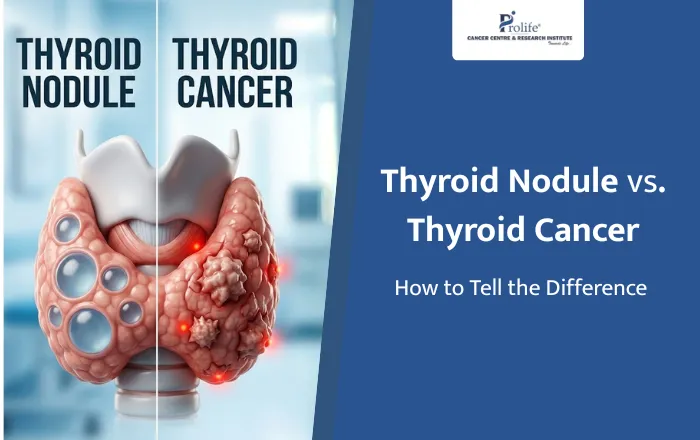
Thyroid Nodule vs. Thyroid Cancer: How to Tell the Difference
Thyroid nodules are far more common than most people realize — up to 60% of adults will develop one by age 60, according to the American Thyroid Association. The good news? Roughly 90–95% of thyroid nodules are benign. But that remaining 5–10% is exactly why understanding early signs of thyroid cancer, thyroid cancer symptoms, and when to consult a thyroid nodule specialist in Pune — including patients searching for a thyroid cancer specialist near Kharadi and nearby areas — matters so much.
What Is a Thyroid Nodule?
A thyroid nodule is a lump or growth within the thyroid gland — part of the endocrine system and the butterfly-shaped organ at the base of your neck that regulates metabolism. Nodules can be solid, fluid-filled (cystic), or mixed. Most cause no symptoms and are discovered incidentally during imaging done for an unrelated reason, or during a routine health check.
Common causes of benign nodules:
- Iodine deficiency
- Hashimoto’s thyroiditis (autoimmune inflammation)
- Colloid nodules (overgrowth of normal thyroid tissue)
- Thyroid cysts
Early Signs of Thyroid Cancer and Thyroid Cancer Symptoms
Most thyroid cancers cause no symptoms in the early stages, which is why they’re often found on a scan done for something else. When symptoms do appear, they typically include:
- A thyroid lump or swelling you or someone else can feel or see in the neck
- Hoarseness or voice changes that don’t go away
- Difficulty swallowing or a sense of pressure in the throat
- Persistent throat discomfort not related to a cold
- Swollen lymph nodes in the neck near the lump
If you notice any of these, searching for a thyroid cancer doctor in Pune, a thyroid cancer doctor near me, or a thyroid lump specialist in Pune promptly — rather than waiting to “see if it goes away” — is the safest approach. Patients researching a thyroid cancer specialist near Kharadi or a thyroid lump specialist near Kharadi should look for a centre that combines ultrasound, cytology, and surgical expertise under one roof, so thyroid swelling treatment in Pune doesn’t get delayed by referrals back and forth.
When a Nodule Might Be Cancer
Thyroid cancer often presents as a single nodule, but size alone doesn’t determine malignancy. What matters more is the nodule’s characteristics on ultrasound, its growth pattern, and certain warning signs — this is really the heart of how to know if a thyroid nodule is cancerous.
Red Flags That Warrant Evaluation
- A nodule that grows rapidly over weeks or months
- Hoarseness or voice changes without a cold
- Difficulty swallowing or a feeling of pressure in the throat
- Enlarged lymph nodes in the neck alongside the nodule
- A firm, fixed nodule that doesn’t move when you swallow
- History of radiation exposure to the head/neck, especially in childhood
- Family history of thyroid cancer or related genetic syndromes (e.g., MEN2)
If any of these features are present, it’s classified as a suspicious thyroid nodule, and suspicious thyroid nodule treatment in Pune should begin with a proper ultrasound work-up rather than a wait-and-watch approach. This is also when many patients start searching for a thyroid oncology specialist near me to get a clear, structured plan rather than piecemeal tests.
Key Differences: Nodule vs. Cancer
| Feature | Benign Nodule | Suspicious for Cancer |
|---|---|---|
| Growth rate | Slow or stable | Rapid |
| Texture | Soft, smooth, mobile | Hard, irregular, fixed |
| Ultrasound features | Smooth borders, cystic | Microcalcifications, irregular margins, increased blood flow |
| Lymph nodes | Normal | Enlarged or abnormal |
| Symptoms | Usually none | Hoarseness, swallowing difficulty |
Understanding Your Ultrasound Report: TI-RADS
Ultrasound is the cornerstone of evaluating any thyroid lump, and every report today comes with a TI-RADS score (Thyroid Imaging Reporting and Data System), which grades a nodule’s cancer risk based on its composition, echogenicity, shape, margins, and calcifications.
- TIRADS 3 nodules are mildly suspicious — usually monitored, biopsied only if larger than 2.5 cm.
- TIRADS 4 thyroid nodule findings are moderately suspicious — biopsy is usually recommended once the nodule crosses about 1.5 cm.
- TIRADS 5 thyroid nodule findings are highly suspicious for malignancy — biopsy is typically advised even at smaller sizes (around 1 cm or less).
Two ultrasound features worth understanding on their own:
- Hypoechoic thyroid nodule meaning: a nodule appears darker than the surrounding thyroid tissue on ultrasound. Hypoechogenicity alone doesn’t mean cancer, but combined with irregular margins or microcalcifications, it raises the TI-RADS score.
- Calcification in a thyroid nodule: tiny, punctate (“micro”) calcifications are one of the stronger red-flag features on ultrasound, while coarse, rim-type calcifications are usually a lower-risk pattern.
Thyroid Nodule With Normal TSH — Does That Rule Out Cancer?
No. A thyroid nodule with normal TSH is actually the most common scenario in thyroid cancer, because most thyroid cancers do not affect hormone production — the gland keeps functioning normally even as a malignant nodule grows within it. TSH testing mainly helps rule out an “overactive” (hot) nodule, which is rarely cancerous and is worked up differently, usually with a radioactive iodine scan rather than an immediate biopsy.
Similarly, when it comes to solid thyroid nodule cancer risk, a solid composition (versus cystic or mostly fluid-filled) is one of several TI-RADS criteria that raises suspicion — but it is only one piece of the picture, evaluated alongside echogenicity, margins, shape, and calcification pattern.
The Diagnostic Pathway
1. Physical Examination Your doctor checks size, texture, mobility, and whether the lymph nodes feel enlarged.
2. Thyroid Ultrasound Assesses size, composition, margins, calcifications, and vascularity, scored using TI-RADS to estimate cancer risk.
3. TSH Blood Test If thyroid hormone levels are abnormal, a different workup (like a radioactive iodine scan) may follow, since “hot” nodules are rarely cancerous.
4. Fine-Needle Aspiration (FNA/FNAC) Biopsy For nodules with suspicious ultrasound features (typically over 1 cm, or smaller with high-risk TI-RADS patterns), an FNAC test for a thyroid lump in Pune is the gold standard next step. A thyroid biopsy specialist in Pune, ideally with a thyroid FNAC specialist in Pune on-site, is important here, since sampling technique and reporting quality directly affect how reliable the result is.
5. Reading a Suspicious Thyroid FNAC Report — The Bethesda System FNAC results are classified using the Bethesda System, which every patient with a suspicious thyroid FNAC report should understand:
- Bethesda 1: Non-diagnostic — needs to be repeated
- Bethesda 2: Benign — routine follow-up
- Bethesda 3 thyroid nodule (AUS/FLUS — atypia of undetermined significance): indeterminate, often needs repeat FNAC or molecular testing
- Bethesda 4 thyroid nodule (follicular neoplasm): moderate-to-high cancer risk (roughly 15–40%); surgery is frequently recommended for a definitive diagnosis
- Bethesda 5 thyroid nodule (suspicious for malignancy): high cancer risk (roughly 60–75%); surgical planning usually proceeds as if cancer is confirmed
- Bethesda 6: Malignant — diagnostic for thyroid cancer
6. Molecular Testing For indeterminate (Bethesda 3 or 4) nodules, genetic panels — testing for mutations like BRAF, RAS, or RET/PTC rearrangements — can help avoid unnecessary surgery by further clarifying cancer risk.
Real-World Example
Consider a 45-year-old woman who notices a small lump while applying lotion to her neck. An ultrasound shows a 1.2 cm nodule with irregular margins and microcalcifications — features that push it into the TIRADS 4 category. An FNAC biopsy returns Bethesda 5, and surgery confirms papillary thyroid carcinoma, the most common and generally most treatable form of thyroid cancer. With early detection and appropriate surgical management, the prognosis is excellent — papillary thyroid cancer has a 10-year survival rate exceeding 95% when caught and treated early.
This scenario underscores why incidental findings shouldn’t be dismissed, and why timely evaluation by an experienced thyroid cancer surgeon in Pune — or the best thyroid cancer specialist in Pune you can access — is critical.
Not All Thyroid Cancers Are the Same
Thyroid lump cancer treatment isn’t one-size-fits-all — the approach depends heavily on which type of thyroid cancer is diagnosed:
- Papillary thyroid cancer treatment in Pune: the most common type (roughly 80% of cases), typically slow-growing with excellent long-term survival when treated with surgery and, where needed, radioactive iodine.
- Follicular thyroid cancer treatment in Pune: the second most common type, can occasionally spread through the bloodstream to the lungs or bone, so post-surgical monitoring is more involved.
- Medullary thyroid cancer treatment in Pune: arises from different thyroid cells, sometimes hereditary (linked to MEN2), and typically requires more extensive surgery plus genetic counselling for the family.
- Recurrent thyroid cancer treatment in Pune: for cancer that returns after initial treatment, management often involves repeat imaging, possible re-operation, and sometimes radioactive iodine or targeted therapy, depending on where and how it has recurred.
Treatment: Thyroid Surgery in Pune
Once cancer is confirmed — or strongly suspected on Bethesda 4/5 cytology — the next conversation is about thyroid cancer treatment in Pune, most often centred on thyroid cancer surgery in Pune. Not every nodule needs an operation, though — benign or low-risk nodules may only need thyroid nodule treatment in Pune in the form of periodic ultrasound monitoring. When surgery is needed, a thyroidectomy surgeon in Pune will base the extent of surgery on tumour size, whether lymph nodes are involved, and the specific type of thyroid cancer:
- Lobectomy (removal of the affected half of the thyroid) for small, low-risk cancers
- Total thyroidectomy (removal of the entire gland) for larger or higher-risk cancers
- Neck dissection for thyroid cancer — central or lateral lymph node surgery for thyroid cancer when nodes show involvement
- Robotic thyroid surgery in Pune and minimally invasive thyroid surgery in Pune, a robotic-assisted approach that can reduce visible scarring and support faster recovery in appropriately selected patients
Because the thyroid sits close to the vocal cord nerves and parathyroid glands, the experience of the operating thyroid surgeon in Pune has a direct bearing on outcomes — both oncological and functional (voice, calcium levels).
Note on thyroid cancer surgery cost in Pune: costs vary considerably depending on the extent of surgery (lobectomy vs. total thyroidectomy), whether lymph node dissection is required, whether a robotic or conventional approach is used, and the hospital’s facility charges. The most reliable way to get an accurate estimate is a thyroid cancer consultation in Pune, where your specific case, imaging, and biopsy results can be reviewed in person.
Getting a Second Opinion or Online Consultation for Thyroid Cancer
If you’ve already been told you need surgery, or you’ve received an indeterminate or suspicious FNAC result, it’s completely reasonable to seek a thyroid cancer second opinion in Pune before proceeding — particularly around how extensive the surgery needs to be, whether robotic techniques are appropriate for your case, and how lymph nodes will be managed. A second opinion doesn’t delay care meaningfully, but it can meaningfully change the treatment plan.
For patients outside the city, or those who simply want to review reports before travelling, a thyroid cancer online consultation is a practical first step — you can book a consultation directly with our team, including patients searching for thyroid surgery near Kharadi, thyroid cancer hospital near Kharadi, or thyroid cancer treatment near Kharadi.
Lifestyle factors also play a role in overall cancer risk and recovery — see our guide on how sleep, stress, and diet affect cancer risk for practical steps you can take alongside medical care.
Frequently Asked Questions
Q1. Can a thyroid nodule be cancerous without symptoms? Yes. Most thyroid cancers, especially in early stages, cause no symptoms at all. This is why ultrasound evaluation — not waiting for symptoms — is essential for accurate assessment.
Q2. Does nodule size determine cancer risk? Not directly. While larger nodules (over 4 cm) carry somewhat higher risk, many small nodules under 1 cm have been diagnosed as cancer, while large nodules are often benign. Ultrasound characteristics (TI-RADS) matter more than size alone.
Q3. Is thyroid cancer hereditary? Some types, particularly medullary thyroid cancer, can run in families and are linked to genetic syndromes. A family history should always be disclosed to your doctor.
Q4. What is the survival rate for thyroid cancer? Differentiated thyroid cancers (papillary and follicular) have excellent outcomes, with survival rates often above 90–95% when treated appropriately and early.
Q5. Should every thyroid nodule be biopsied? No. Biopsy decisions depend on size, ultrasound features, and TI-RADS scoring. Many nodules are simply monitored with periodic ultrasounds.
Q6. What does a Bethesda 3 or 4 result mean for me? Both are “indeterminate” categories. Bethesda 3 often means repeating the FNAC or doing molecular testing; Bethesda 4 carries a higher cancer risk and surgery is frequently recommended to reach a definitive diagnosis.
Q7. What determines thyroid cancer surgery cost in Pune? The extent of surgery, whether lymph node dissection is needed, robotic vs. conventional technique, and hospital stay all factor in — an in-person or online consultation is the best way to get a case-specific estimate.
Have questions? We’re just a message away! Contact us on WhatsApp — Click Here to Chat with Us
What to Do If You Find a Nodule
- Don’t panic, but don’t ignore it. Schedule an evaluation within a few weeks.
- Get a TSH test and ultrasound as baseline workup.
- Ask for your TI-RADS score to understand risk stratification.
- If biopsy is recommended, get it done — delays can complicate treatment timing.
- Seek a specialist with surgical oncology expertise if results are suspicious or indeterminate, since management decisions significantly affect outcomes.
Why Specialist Care Matters — Consultation With Dr. Sumit Shah
Thyroid cancer treatment decisions — whether to operate, how extensive the surgery should be, whether robotic-assisted techniques are appropriate, and how to manage lymph node involvement — require nuanced surgical oncology expertise.
Prolife Cancer Centre, a leading thyroid cancer hospital in Pune offering comprehensive Prolife Cancer Centre thyroid cancer treatment, is led by Dr. Sumit Shah — Dr. Sumit Shah, thyroid cancer surgeon, and Robotic Cancer Surgeon with over 22+ years of experience. As Founder and Chief Consultant, Dr. Shah brings advanced robotic surgical techniques and deep oncological expertise to thyroid nodule evaluation and cancer management — giving patients across Pune, including those searching for a thyroid cancer hospital near Kharadi, as well as Wanowrie, Kondhwa, and Hinjewadi, access to precise, minimally invasive, and outcome-focused care. Dr. Sumit Shah personally reviews ultrasound and FNAC findings for patients seeking a thyroid cancer consultation in Pune, including those seeking a second opinion.
If you’ve been told you have a thyroid nodule with suspicious features, or have received an indeterminate biopsy result, consulting an experienced thyroid cancer specialist in Pune early can make a meaningful difference in both treatment approach and long-term outcomes. You can also explore related head and neck cancer care at Prolife Cancer Centre.
Name — Dr. Sumit Shah – Breast, Oral, Colon Cancer Specialist in Pune | Prolife Cancer Centre Address: 557A1, 15C, Jawaharlal Nehru Rd, Burhanj Baug-B Colony, Market Yard, Gultekadi, Pune, Maharashtra 411037 Phone: 96070 79019
Tags: thyroid cancer specialist in Pune, thyroid cancer doctor in Pune, thyroid cancer surgeon in Pune, best thyroid cancer specialist in Pune, thyroid cancer hospital in Pune, thyroid cancer treatment in Pune, thyroid cancer surgery in Pune, thyroid surgeon in Pune, thyroid oncology specialist near me, thyroid cancer doctor near me, thyroid cancer hospital near me, thyroid cancer treatment near me, thyroid cancer surgery cost in Pune, robotic thyroid surgery in Pune, minimally invasive thyroid surgery in Pune, thyroidectomy surgeon in Pune, thyroid nodule specialist in Pune, thyroid lump specialist in Pune, thyroid nodule treatment in Pune, thyroid biopsy specialist in Pune, FNAC test for thyroid lump in Pune, thyroid lump cancer treatment, thyroid swelling treatment in Pune, thyroid cancer second opinion in Pune, thyroid cancer consultation in Pune, thyroid cancer online consultation, papillary thyroid cancer treatment in Pune, follicular thyroid cancer treatment in Pune, medullary thyroid cancer treatment in Pune, recurrent thyroid cancer treatment in Pune, lymph node surgery for thyroid cancer, neck dissection for thyroid cancer, Dr. Sumit Shah thyroid cancer surgeon, Prolife Cancer Centre thyroid cancer treatment, thyroid cancer specialist near Kharadi, thyroid cancer surgeon near Kharadi, thyroid cancer treatment near Kharadi, thyroid surgeon near Kharadi, thyroid cancer hospital near Kharadi, thyroid lump specialist near Kharadi, thyroid nodule treatment near Kharadi, thyroid surgery near Kharadi
Related reading:
- पुण्यातील रोबोटिक थायरॉईड शस्त्रक्रिया: प्रोलाइफ कॅन्सर सेंटर, डॉ. सुमित शाह (Robotic Thyroid Surgery in Pune)
- कंपनी हेल्थ चेकअपमध्ये थायरॉईड नोड्यूल आढळला? (Thyroid Nodule Found in a Health Check-up)
- थायरॉइड लंप या सूजन? Kondhwa मरीज़ों के लिए गाइड (Thyroid Lump or Swelling — A Guide)
- How Sleep, Stress, and Diet Affect Cancer Risk
- Head and Neck Cancer Treatment in Pune
- Cancer Surgery in Kharadi, Pune
