


Disadvantages of Vacuum-Assisted Breast Biopsy: Risks, Limits and What to Expect
Medically reviewed by Dr. Sumit Shah, Prolife Cancer Centre & Research Institute, Pune
Key points
- Vacuum-assisted breast biopsy (VABB) is a safe, image-guided procedure, but it has some drawbacks.
- The main ones are bruising or hematoma, higher cost, positioning difficulty and rare complications such as infection.
- Because VABB can remove most or all of a small lesion, a marker clip is usually placed so the area can be found later.
- Serious complications are uncommon. Your radiologist or Breast Cancer Doctor In Pune can tell you which biopsy method suits your lesion.
What is a vacuum-assisted breast biopsy?
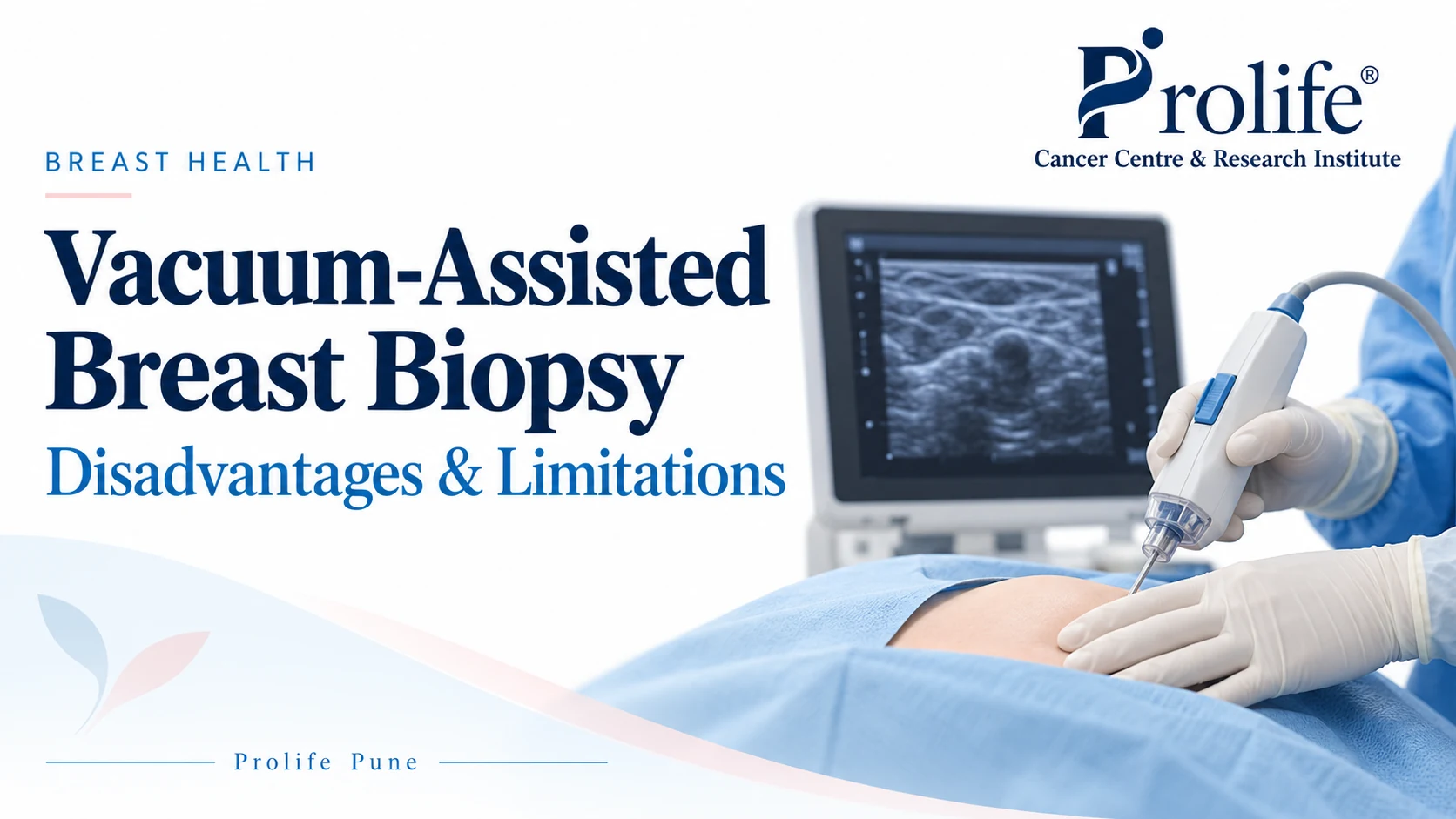
A vacuum-assisted breast biopsy uses a hollow probe and gentle suction to collect several tissue samples through one small skin opening. It is guided by ultrasound, stereotactic mammography or MRI. Doctors use it to diagnose suspicious lumps and calcifications, and to sample areas a standard core needle may miss. If cancer is confirmed, the next step is a treatment plan. Prolife offers Breast Cancer Treatment In Pune, including breast cancer surgery.
What are the disadvantages of vacuum-assisted breast biopsy?
1. Is there a higher risk of bruising and hematoma?
Yes. VABB uses a larger probe and removes more tissue than a standard core needle biopsy, so bruising, swelling and hematoma (a collection of blood) are somewhat more likely. Most bruises settle in a few days to weeks, and a larger hematoma occasionally needs to be checked or drained.
2. Is VABB more expensive?
Generally yes. The single-use probe and vacuum system cost more than the equipment for a standard automated core needle biopsy. Costs vary by hospital, imaging method and insurance coverage, so ask for an estimate before the procedure.
3. Can VABB make later surgical planning harder?
It can. If the biopsy removes most or all of a small lesion, the spot may become hard to see on imaging. Radiologists therefore place a small marker clip in the biopsy cavity. This is not really a flaw in the test, but it adds a step, and a missing or displaced clip can complicate surgery.
4. Can it affect measuring tumour size or grading borderline lesions?
Removing a large part of a lesion can make it harder to judge its original size on later scans. Findings such as atypical ductal hyperplasia (ADH) or DCIS can also be reclassified (upgraded) after surgery, which is true of any biopsy. A Breast Cancer Specialist In Pune will decide whether follow-up surgery or monitoring is needed.
5. Are there positioning and access limitations?
- Stereotactic and some MRI-guided procedures may need you to lie still for a long time, sometimes face-down on a table.
- This can be uncomfortable with back, neck or shoulder problems, limited mobility or anxiety.
- Lesions very close to the chest wall, deep in the breast or near the armpit can be harder to reach safely.
- Thin breasts or lesions close to the skin may need a different technique.
6. What rare complications can occur?
- Infection: uncommon.
- Pain or tenderness at the site.
- Bleeding that lasts longer than expected.
- Pneumothorax (collapsed lung): very rare, and a concern only for lesions near the chest wall.
- Implant injury: a consideration if you have breast implants, so tell your doctor beforehand.
Vacuum-assisted vs core needle biopsy at a glance
| Feature | Vacuum-assisted (VABB) | Core needle biopsy |
| Tissue per pass | More, in several samples | Smaller, one sample per pass |
| Bruising/hematoma | Slightly higher | Lower |
| Cost | Higher | Lower |
| Best for | Calcifications, small or complex lesions, benign removal | Most palpable or clearly visible lumps |
| Marker clip | Commonly placed | Placed when needed |
When should you call your doctor after a breast biopsy?
Contact your doctor if you notice:
- Rapidly increasing swelling or a hard, painful lump
- Bleeding that does not stop with gentle pressure
- Fever, redness, warmth or pus at the site
- Breathlessness or chest pain (seek emergency care)
How can you notice breast changes early?
A biopsy is usually advised after a lump or an abnormal scan is found. Regular checks help you spot changes sooner, and our guide on how to perform a breast self-examination at home walks you through it step by step.
Where can I get a breast biopsy in Pune?
Prolife Cancer Centre & Research Institute at Market Yard (Gultekdi) is a Breast Cancer Hospital In Pune that offers breast evaluation and treatment. Your biopsy method is chosen on your imaging findings, breast size, lesion position and overall health.
If your biopsy shows cancer, you can see a Breast Cancer Surgeon In Pune to plan surgery, or consult a Surgical Oncologist In Pune about your overall treatment. Meet Dr. Sumit Shah or book an appointment for a consultation.
FAQs
Is a vacuum-assisted breast biopsy painful?
Local anaesthesia is used, so most people feel pressure rather than sharp pain. Some soreness is common for a few days.
How long does recovery take?
Most people resume normal activity within a day or two. Avoid strenuous exercise as advised, and expect bruising to fade over one to two weeks.
Is VABB better than a core needle biopsy?
Neither is better in every case. VABB samples more tissue and suits small lesions and calcifications, and a core needle is simpler for many clear lumps.
Can VABB remove a lump completely?
It can remove small benign lesions entirely, but it is mainly a diagnostic test, not a replacement for surgery when cancer is found.
Do I always need a marker clip?
Not always, but it is commonly placed after VABB so the site can be found for follow-up or surgery.
Worried about a breast lump or an abnormal scan? Book a consultation with Dr. Sumit Shah.
This article is for education and does not replace medical advice. Please consult your doctor about your own situation.
