


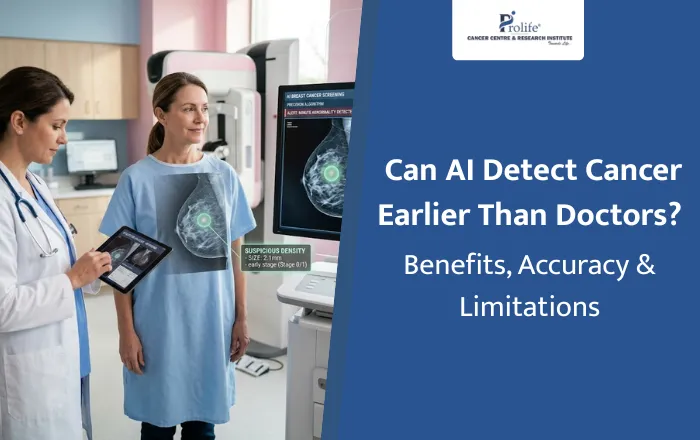
What if a computer could spot cancer in your body before you felt even a single symptom? No pain, no lump, no warning sign just a quiet signal hidden in a scan or a blood test that a machine catches before any human eye does. It sounds like something from a science fiction movie, but AI cancer detection is very much a reality today and it’s growing fast.
But before you start trusting an app with your health, there’s a lot worth understanding. Can artificial intelligence cancer diagnosis truly outperform a trained doctor? Where does it help, and where does it fall short? Let’s break it all down in plain, simple language.
Why Early Cancer Detection Changes Everything
When cancer is caught early — at Stage 1 or Stage 2 — the chances of successful treatment are dramatically higher. For example, early cancer detection in breast cancer at Stage 1 carries survival rates above 90%. That same cancer, caught at Stage 4, tells a very different story.
The tragic reality is that in India, over 70% of cancer cases are diagnosed at an advanced stage. Why? Because early-stage cancer often causes no symptoms. People feel fine until they don’t. This is exactly where AI in oncology steps in with real promise.
How AI Is Being Used to Detect Cancer
AI cancer detection works by training computer algorithms on thousands — sometimes millions — of medical images, blood test results, and patient records. Over time, the AI learns to recognize patterns that might indicate cancer, often patterns too subtle for the human eye to catch consistently.
Here’s how it’s being applied right now:
- AI and Medical Imaging: In radiology, AI cancer diagnosis tools analyze X-rays, CT scans, MRIs, and mammograms in seconds. Some systems have shown accuracy rates above 94% in detecting specific cancers on imaging scans. In breast cancer screening, AI has helped reduce false positives by up to 5–11% in certain trials — meaning fewer women going through unnecessary biopsies.
- AI in Pathology: When a biopsy sample is examined under a microscope, AI tools assist pathologists by flagging abnormal cell clusters. This is particularly useful in detecting lung, colon, and cervical cancers early.
- Liquid Biopsies and Blood Tests: One of the most exciting developments in early cancer detection technology is the AI-powered blood test. These tests look for fragments of cancer DNA circulating in your bloodstream — potentially detecting cancer before a tumor even becomes visible on a scan.
5 Real Benefits of AI in Early Cancer Detection
1. Speed: AI can analyze a complex medical scan in seconds. This matters enormously in high-volume hospitals where radiologists are stretched thin.
2. Consistency: A doctor can have an off day. AI cancer screening tools apply the same level of attention whether it’s 9 AM or 2 AM.
3. Accessibility: AI-assisted tools could bring early cancer detection to smaller towns and cities in India where specialist oncologists are scarce.
4. Pattern Recognition: AI in oncology is trained on millions of cases, giving it the ability to spot micro-patterns that might be easy to overlook — especially in skin cancer and colorectal cancer screening.
5. Fewer Missed Cancers: Used alongside a radiologist, AI acts as a reliable second pair of eyes — catching cases that might otherwise slip through.
The Honest Limitations of AI Cancer Detection
Here’s where we need to be very real with you because AI cancer diagnosis accuracy has limits that matter deeply for patients.
- AI cannot replace clinical judgment. A scan is just one piece of information. An experienced oncologist also considers your symptoms, family history, lifestyle, mental health, and a dozen other factors that no algorithm currently processes. Can AI detect cancer the way a doctor thinks about cancer? Not yet.
- False positives remain a problem. In some applications, AI flags too many cases as suspicious, leading to unnecessary tests, stress, and cost.
- Dataset bias is a serious concern. Most AI cancer detection tools were trained on data from Western countries. Indian patients can have different cancer presentations and genetic profiles — which means these tools may not perform equally well for everyone in India.
- The “black box” problem: Many AI systems can’t clearly explain why they flagged something as suspicious. Oncologists need to explain diagnoses to patients in a way a machine simply cannot.
AI + Doctor: The Winning Combination
The smartest way to think about AI vs doctor cancer diagnosis is not as a competition — it’s a partnership. AI handles speed and scale. The doctor provides judgment, compassion, and context. Think of it like GPS: it helps you navigate, but you’re still the one driving.
Consumer AI apps and online symptom checkers are not replacements for a specialist. Using them to self-diagnose can create unnecessary fear or worse, false reassurance.
Take the Next Step — Your Health Can’t Wait
AI cancer detection is a powerful tool, but it works best in the hands of a skilled oncologist who can put everything together and guide you forward.
If you have a family history of cancer, unexplained symptoms, or simply want a professional screening, now is the time to act. At Prolife Cancer Centre, Pune’s trusted cancer hospital in Pune, Dr. Sumit Shah — Senior Surgical Oncologist and founder — brings years of hands-on experience treating all types of cancers with skill, honesty, and genuine care for every patient.
Don’t wait for a symptom to force your hand. Early action is always your strongest move.
📞 24×7 Helpline: +91-9607079019 / +91-9607079029 🌐 Book your consultation today
Name – Dr. Sumit Shah – Breast, Oral, Colon Cancer Specialist in Pune | Prolife Cancer Centre
Address: 557A1, 15C, Jawaharlal Nehru Rd, Burhanj Baug-B Colony, Market Yard, Gultekadi, Pune, Maharashtra 411037
Phone: 96070 79019
Frequently Asked Questions
Q1. Can AI detect cancer without a doctor?
No. AI supports diagnosis but cannot replace a qualified oncologist who evaluates your complete health picture.
Q2. How accurate is AI in detecting cancer?
Accuracy varies by cancer type. In breast and lung cancer imaging, some AI tools have matched specialist-level performance — but results depend heavily on the tool and the dataset it was trained on.
Q3. Is AI cancer detection available in Pune or India?
Select private hospitals in cities like Pune are beginning to use AI-assisted diagnostics. However, it is not yet widely available across India.
Q4. Should I use an AI app to check for cancer symptoms?
No. Consumer apps are not diagnostic tools. Always consult a trained oncologist for any cancer-related concerns.
Have questions? We’re just a message away! Contact us on WhatsApp — Click Here to Chat with Us
