

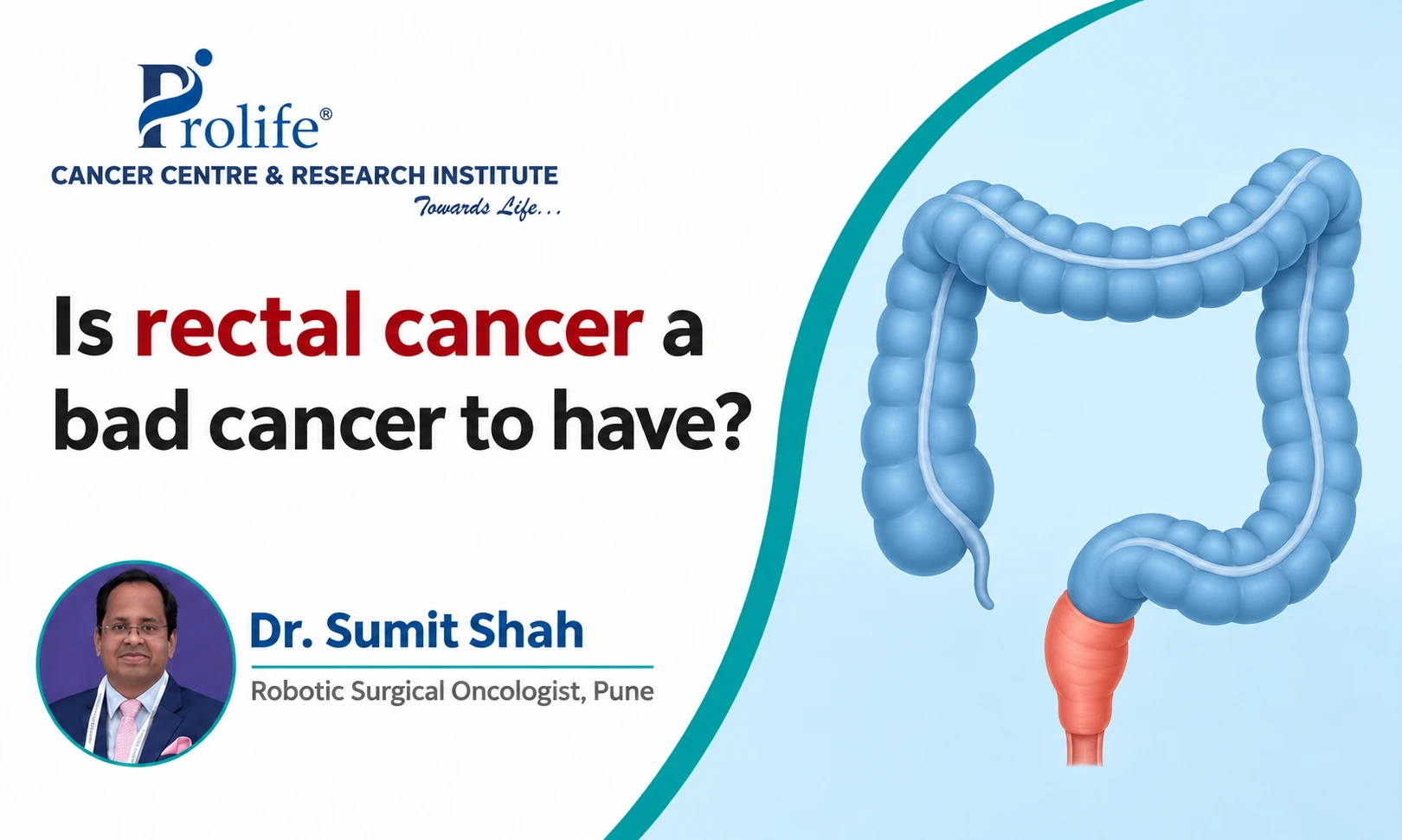
Is rectal cancer a bad cancer?
Rectal cancer is a serious disease, but it is often treatable and frequently curable, especially when found early. American Cancer Society data (SEER, people diagnosed 2014–2020) show a 5-year relative survival of about 90% when the cancer is localised, 74% when it has spread regionally and 18% when it has spread to distant organs, with 67% across all stages combined. Stage at diagnosis, tumour position and genetic markers matter far more than the label “bad”.
Key points
- Rectal cancer is not one of the “worst” cancers. Outcomes are strongly linked to how early it is found.
- It is harder to treat than colon cancer because the rectum sits in a tight pelvic space, so treatment is more complex and local recurrence needs special attention.
- Most rectal cancers start as polyps that take years to turn cancerous, so screening and polyp removal can prevent many cases.
- Modern care often combines chemotherapy and radiation before surgery, and some tumours respond very well to immunotherapy.
- A permanent colostomy is needed only in some low-lying tumours, not in everyone.
- Bleeding, a lasting change in bowel habit or a feeling of incomplete emptying should be checked, not assumed to be piles.
Why is rectal cancer harder to treat than colon cancer?
The rectum is the last part of the large bowel and lies deep in the pelvis. It is close to the bladder, prostate or uterus; the nerves that control bladder and sexual function; and the muscles that control stool. This tight space leaves little margin for the surgeon.
The lower rectum also lacks the smooth outer covering (serosa) that wraps much of the colon, so a tumour can reach nearby tissue and lymph nodes more easily. For these reasons, rectal cancer carries a higher risk of coming back locally than colon cancer. It is usually planned by a team rather than treated with surgery alone.
What is the survival rate for rectal cancer?
These US figures are from the American Cancer Society, based on SEER data for people diagnosed between 2014 and 2020.
| Stage at diagnosis (SEER) | 5-year relative survival |
|---|---|
| Localised (confined to the rectum) | 90% |
| Regional (nearby tissue or lymph nodes) | 74% |
| Distant (spread to other organs) | 18% |
| All stages combined | 67% |
Two things to keep in mind. First, these are averages for large groups and cannot predict what will happen for one person. Second, they describe people treated at least five years ago, and treatment has improved since. Figures from India can differ because of later diagnosis, so your own stage and test results are the best guide.
Can rectal cancer be cured?
Yes, in many cases. When rectal cancer is found at an early stage (Stage 0 or Stage I), before it has spread beyond the bowel wall, the chance of cure is high. Even in locally advanced disease, combining chemotherapy, radiation and surgery can achieve cure for many patients. Cure becomes harder once the cancer has spread to distant organs, though treatment can still control it for long periods.
How is rectal cancer treated?
Treatment depends on stage, how far the tumour is from the anal opening and the tumour’s genetic profile. Options include:
- Surgery: removal of the tumour with the surrounding lymph nodes. Early tumours may need only a limited local excision, while others need sphincter-saving surgery or, rarely, removal of the rectum and anus.
- Chemotherapy and radiation before surgery: often used for rectal cancer that has grown through the wall or reached lymph nodes, to shrink the tumour and lower recurrence risk.
- Chemotherapy after surgery: used when lymph nodes or other features suggest a higher risk of return.
- Immunotherapy: tumours with mismatch repair deficiency (dMMR) or high microsatellite instability (MSI-H) can respond very well. This is why tumour testing is done.
- Minimally invasive surgery: laparoscopic and robotic approaches can help in the narrow pelvis, depending on the case and the surgeon’s expertise.
- Organ-preserving or watch-and-wait approaches: in carefully selected patients who respond fully to pre-surgery treatment, close monitoring may be offered instead of immediate surgery.
To see how this is planned at our centre, read about our rectal cancer specialist in Pune service.
Will I need a permanent colostomy?
Not necessarily. Many people keep normal bowel function after surgery, and some need only a temporary stoma while the join heals. A permanent colostomy is usually considered only when the tumour is very low and involves the muscles that control stool. Your surgeon can tell you before surgery how likely this is for your tumour.
What are the early symptoms of rectal cancer?
See a doctor if you notice any of the following, especially if they last more than a few weeks:
- Blood in or on the stool, or bleeding from the back passage
- A lasting change in bowel habits, such as new constipation, diarrhoea or narrower stools
- A feeling that the bowel is not completely empty
- Pain or a sense of pressure in the rectum or pelvis
- Unexplained weight loss, tiredness or anaemia
Bleeding is often blamed on piles (haemorrhoids), but a doctor should confirm this with an examination. Rectal and colon cancers are also being diagnosed more often in people under 50, so age should not be a reason to wait.
Can rectal cancer be prevented or found early?
Most rectal cancers develop from non-cancerous polyps (adenomas) over many years, though some tumours grow faster. A colonoscopy can find and remove polyps before they become cancer. Screening usually begins at 45–50 for average-risk adults, and earlier if you have a family history, inflammatory bowel disease or inherited conditions. Ask your doctor which schedule suits you.
Rectal cancer treatment in Pune
Rectal cancer treatment works best when planned by a multidisciplinary team. At Prolife Cancer Centre & Research Institute in Gultekdi, Market Yard, you can consult a cancer specialist in Pune for evaluation, staging and a treatment plan. Dr Sumit Shah is a surgical oncologist at the centre. To discuss a diagnosis or a second opinion, book an appointment or call +91 9607079019.
For dedicated rectal care, visit our rectal cancer specialist in Pune page for more detail on evaluation, staging and treatment.
Frequently asked questions
Is rectal cancer a death sentence?
No. Many people with rectal cancer are cured, especially when it is found early. Outlook depends mainly on stage, so early diagnosis makes the biggest difference.
Is rectal cancer worse than colon cancer?
The overall 5-year survival is similar (67% for rectal and 63% for colon in ACS data), but rectal cancer is more complex to treat and has a higher risk of local recurrence.
How fast does rectal cancer grow?
Most start as polyps that take roughly 10 to 15 years to become cancer, but growth speed varies, and some tumours progress faster.
What is the most common first sign of rectal cancer?
Rectal bleeding and a lasting change in bowel habit are the most common early signs. Both need medical evaluation.
Can rectal cancer come back after treatment?
Yes, it can recur, which is why follow-up with scans, blood tests and colonoscopy is important for several years after treatment.
