


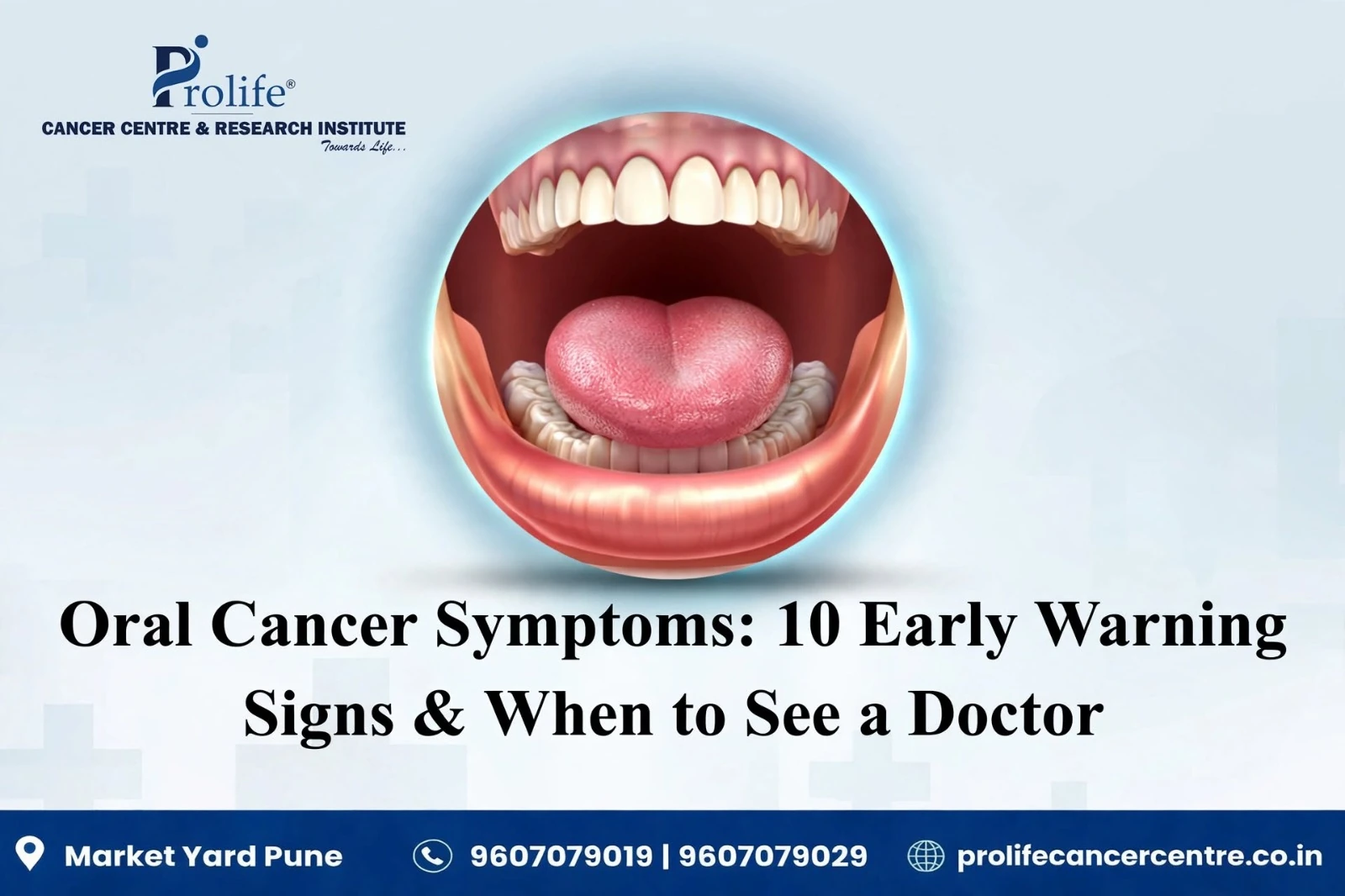
Oral Cancer Symptoms: 10 Early Warning Signs & When to See a Doctor
Medically reviewed by Dr Sumit Shah, Prolife Cancer Centre & Research Institute, Pune
Quick answer: The most common early oral cancer symptoms are a mouth ulcer that does not heal in 2 weeks, white or red patches, a lump or thickening, unexplained bleeding, and difficulty opening the mouth. If any of these last more than 2 weeks, see a doctor or oral cancer specialist, especially if you use tobacco, gutkha, paan or supari.
What Is Oral Cancer?
Oral cancer, also called mouth cancer, is a cancer that starts in the tissues of the mouth. It can affect the lips, tongue, inner cheeks, gums, floor of the mouth, roof of the mouth (palate), and sometimes the tonsils and back of the throat.
Oral cancer is among the most common cancers in India, largely because of tobacco and areca nut use. The good news is that when it is found early, it is far more treatable, and treatment is usually less extensive.
What Are the Early Symptoms of Oral Cancer?
Many mouth problems are harmless and settle in days. What matters is that the change persists. Here are the 10 early warning signs of mouth cancer to know.
1. A Mouth Ulcer That Does Not Heal in 2 Weeks
A sore, cut or ulcer that stays for more than 2 weeks is the most important warning sign. Ordinary canker sores usually heal within 7 to 10 days. A cancerous ulcer persists and may grow. It can be painless at first, which is why many people ignore it.
2. White Patches in the Mouth (Leukoplakia)
Leukoplakia appears as white patches on the tongue, cheeks or gums that cannot be scraped off. Many are harmless, but some are pre-cancerous and need a doctor’s examination and sometimes a biopsy.
3. Red or Velvety Patches (Erythroplakia)
Erythroplakia looks like a red, velvety patch, sometimes slightly raised or depressed. It is less common than leukoplakia but carries a higher chance of turning cancerous, so it needs prompt evaluation.
4. Difficulty Opening the Mouth (Oral Submucous Fibrosis)
If your mouth opens less than before, or you feel stiffness, burning with spicy food, or trouble chewing, it may be oral submucous fibrosis (OSMF). OSMF is strongly linked to chewing gutkha, pan masala and supari, and it is a recognised pre-cancerous condition. It needs medical evaluation, not home remedies.
5. A Lump, Thickening or Swelling in the Mouth or Neck
Any unexplained lump on the tongue, cheek, gums or palate should be examined. A new or growing lump in the neck may be an enlarged lymph node, which can be a sign that cancer has spread.
6. Unexplained Bleeding in the Mouth
Bleeding from a sore or patch, without an injury or recent dental work, needs prompt checking.
7. Difficulty or Pain While Swallowing, Chewing or Speaking
Persistent pain while swallowing, a feeling that food is stuck, painful chewing, or a lasting change in voice (hoarseness, muffled speech) can point to an oral or throat problem.
8. A Sore Throat or “Something Stuck” Feeling That Doesn’t Go Away
A sore throat that lasts for weeks and does not respond to usual treatment should be checked, especially with other symptoms.
9. Numbness, Pain or Tenderness in the Mouth or Face
Unexplained numbness or persistent pain can mean a growing lesion is pressing on a nerve.
10. Loose Teeth Without a Dental Reason
Teeth that loosen with no gum disease or injury can be a sign of a growth affecting the jawbone. Unexplained weight loss, usually a later sign, also needs attention alongside any of the above.
Quick reference table
| Symptom | Looks or feels like | Act when |
|---|---|---|
| Non-healing ulcer | A sore or wound may be painless. | Not healed in 2 weeks |
| Leukoplakia | White patch that can’t be scraped off | Any persistent patch |
| Erythroplakia | Red, velvety patch | See a doctor promptly. |
| OSMF | Stiff mouth, reduced opening | As soon as noticed |
| Lump | Thickening in mouth or neck | Persists or grows |
| Bleeding | No clear injury | Repeats or persists |
What Causes Oral Cancer? Key Risk Factors
Tobacco in Any Form
Gutkha, paan, supari, khaini, beedi and cigarettes are the biggest risk factors for mouth cancer. They expose the lining of the mouth to cancer-causing chemicals again and again. Risk rises with how long and how often you use them.
Alcohol
Heavy alcohol use raises risk, and drinking along with tobacco raises it much more than either alone.
Other Risk Factors
- HPV (human papillomavirus) infection, linked mainly to cancers at the back of the throat and tonsils
- Sun exposure without lip protection, linked to lip cancer
- Chronic irritation from sharp teeth or ill-fitting dentures
- Poor oral hygiene
- A diet low in fruits and vegetables
- Family history, which plays a smaller role
When Should You See a Doctor?
See a doctor or dentist if any of the symptoms above last longer than 2 weeks, particularly if you use tobacco. Do not wait for pain, since early oral cancer is often painless. Waiting and self-treating with home remedies lets a treatable problem advance.
Consult an oncologist promptly if you notice a non-healing ulcer, a growing lump, a white or red patch, or reduced mouth opening. You can meet a mouth cancer oncologist in Pune at Prolife or read about our oral cancer specialist in Pune care approach.
How Is Oral Cancer Diagnosed?
- Clinical examination: the doctor checks your lips, tongue, cheeks, gums, palate and neck.
- Biopsy: a small tissue sample is examined under a microscope. This is the only way to confirm cancer.
- Imaging (CT, MRI or PET-CT): used when needed to see how far a lesion has spread.
Learn more about oral cancer treatment in Pune and when each approach is used.
How Can You Prevent Oral Cancer?
- Quit tobacco in all forms, including gutkha, paan masala and supari.
- Limit or avoid alcohol.
- Do a monthly self-check of your mouth in good light, including under the tongue and inside the cheeks.
- Get regular dental check-ups. Dentists often spot early changes first.
- Eat plenty of fruits and vegetables and keep up good oral hygiene.
- Ask your doctor about HPV vaccination if relevant.
- Protect your lips from the sun.
Be Aware, Act Early
Your mouth often gives early warnings. If something has not settled in 2 weeks, get it checked. Early diagnosis can make treatment simpler and improve outcomes.
If you are concerned, consult a mouth cancer oncologist in Pune at Prolife Cancer Centre & Research Institute, Market Yard, Gultekdi, Pune. If you already have a diagnosis, you can also ask for a second opinion. You can read more about mouth cancer specialists in Pune care too.
Book an appointment: call +91 96070 79019.
Frequently Asked Questions About Oral Cancer Symptoms
What are the first signs of oral cancer?
The first signs are usually a mouth ulcer that doesn’t heal in 2 weeks, a white or red patch, a lump, or unexplained bleeding. Early oral cancer is often painless.
Is oral cancer painful in its early stages?
Often not. Many early lesions cause little or no pain, so a painless ulcer or patch that persists should still be checked.
Can dentures or braces cause oral cancer?
They do not directly cause cancer. However, ill-fitting dentures or sharp teeth that irritate the same spot over a long time can add to the risk, especially alongside tobacco use. Get any fit problem or sore spot checked.
How quickly can oral cancer spread?
It varies from person to person. Some lesions grow slowly, others quickly, and oral cancer can spread to lymph nodes in the neck. This is why early evaluation matters. There is no safe waiting period.
Are there foods or drinks that raise oral cancer risk besides alcohol?
Chewing betel quid and areca nut (supari) carries a clear risk. A diet low in fruits and vegetables may also raise risk. Avoiding all tobacco and areca nut products is the most effective step.
What are the long-term effects of oral cancer treatment on speech and eating?
This depends on the site and extent of the cancer and the treatment used. Some people have temporary or lasting changes in chewing, swallowing or speech. Speech and swallowing therapy and reconstruction options can help. Your treating team will explain what to expect for your case.
Which oral cancer symptoms are most serious?
A non-healing ulcer, red patch, growing lump, bleeding, trouble swallowing and a neck lump all need prompt medical attention.
When should I see a doctor for a mouth ulcer?
If it lasts longer than 2 weeks or keeps coming back in the same place, see a doctor.
This article is for education and is not a substitute for medical advice. Only a clinical examination and biopsy can confirm oral cancer.
