

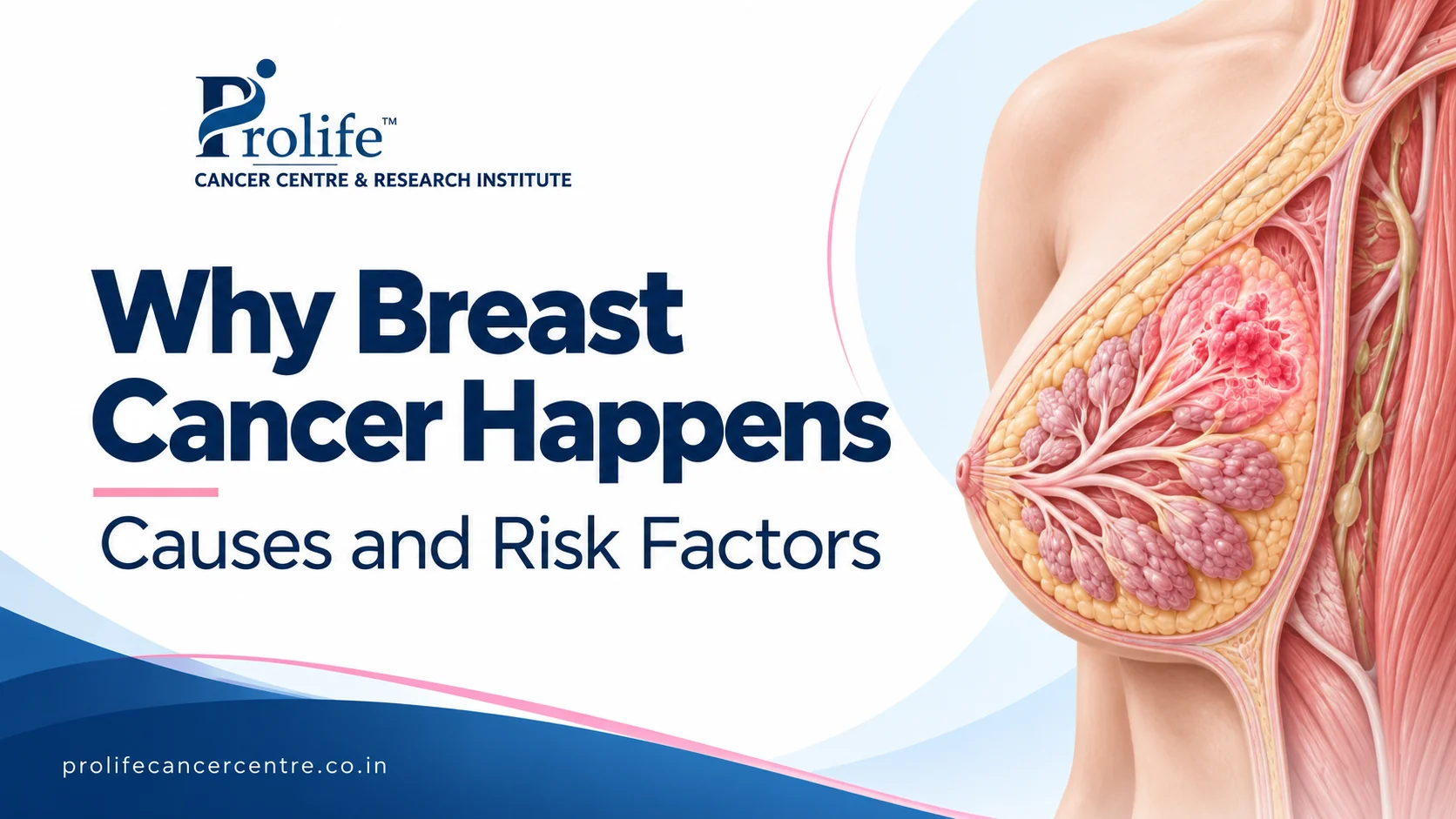
Why Breast Cancer Happens: Causes and Risk Factors
Breast cancer happens when cells in the breast change and grow out of control. In most women there is no single cause. It usually results from a mix of factors such as age, hormones, inherited gene changes, family history and lifestyle. Having a risk factor does not mean you will develop breast cancer, and many women who do develop it have no clear risk factor.
What causes breast cancer in women?
Doctors do not know the exact cause of breast cancer in any one person. Cells in the breast acquire changes (mutations) in their DNA that let them multiply abnormally. What triggers these changes varies, which is why doctors talk about risk factors rather than a single cause. For a broader overview, see our guide on what causes breast cancer.
Risk factors raise the chance of developing the disease but do not guarantee it. Reports suggest approximately 75% of women diagnosed with breast cancer have no known risk factors. That is why regular breast cancer screening matters for every woman, not only those at higher risk.
What are the common causes and risk factors?
Factors you cannot change
- Age. Risk rises as you get older, and most breast cancers are diagnosed after 50, though it can occur at any age.
- Family history of breast cancer. Risk is higher if a mother, sister or daughter has had breast cancer, particularly if they were diagnosed young or several relatives are affected. A family history of ovarian cancer also matters.
- Inherited gene changes. Changes in genes such as BRCA1 and BRCA2 are linked to significantly higher lifetime risk. One public health source estimates around 5% of breast cancers are due to inherited genetic factors. You can read more about how genetic testing is changing cancer treatment.
- Longer lifetime hormone exposure. Starting periods before age 12 or reaching menopause after 55 slightly raises risk, probably because of longer exposure to oestrogen.
- Previous breast conditions. Some non-cancerous changes found on breast biopsy, such as atypical hyperplasia, increase risk.
- Earlier chest radiation, especially when given at a young age.
Factors you may be able to influence
- Alcohol. Studies link drinking to higher risk, and the risk increases with the amount of alcohol consumed.
- Weight and activity. Overweight and obesity after menopause moderately raise risk, and regular physical activity is associated with lower risk.
- Hormone therapy after menopause, particularly combined oestrogen-progestin treatment.
- Pregnancy and breastfeeding patterns. Having a first child after 30, or never having a full-term pregnancy, is associated with slightly higher risk. Breastfeeding is associated with lower risk.
Not sure where you stand? Our breast cancer risk assessment article explains how risk is estimated.
Does family history mean I will get breast cancer?
No. Family history is important, but more than 70% of women who develop breast cancer do not have a family history of the disease. The reverse is also true: having an affected relative does not mean you will develop it.
It is worth speaking to a doctor if:
- Several close relatives on the same side of the family had breast or ovarian cancer
- A relative was diagnosed at a young age
- A male relative had breast cancer
- A known gene change runs in your family
A doctor can assess your overall risk and advise whether genetic counselling, earlier screening or other steps make sense for you.
Common myths about why breast cancer happens
- “It is caused by a bump or injury to the breast.” There is no evidence that a knock causes cancer.
- “Only women with a family history get it.” Most women diagnosed have no family history.
- “A lump is always cancer.” Most breast lumps turn out to be non-cancerous, but any new lump needs checking. Read the truth about breast lumps.
- “I did something wrong.” Breast cancer is not a punishment or a personal failing. Many people who live healthily still develop it.
More myths are covered in dispelling breast cancer myths.
Can I lower my risk?
You cannot remove risk entirely, but sensible steps may help:
- Limit alcohol
- Stay physically active and maintain a healthy weight
- Discuss the benefits and risks of hormone therapy with your doctor
- Know your family history and share it with your doctor
- Learn how to do a breast self-examination at home so you notice changes early
- Attend recommended screening. Our guide to mammogram vs ultrasound explains which test suits which situation
Screening does not prevent breast cancer, but it helps find it early, when treatment is often more effective. See our breast cancer prevention and screening page for more.
When should I see a doctor?
Arrange an assessment if you notice a new breast lump, a change in breast shape or size, skin dimpling or redness, nipple changes or discharge, or underarm swelling. Our article on the first warning signs of breast cancer lists these in more detail. You should also speak to a doctor if you have a strong family history and have not discussed screening.
Prolife Cancer Centre & Research Institute in Market Yard, Gultekdi, Pune, offers breast cancer evaluation and treatment, along with cancer screening and treatment planning. You can book an appointment or contact the centre with questions.
If you are looking for a Breast Cancer Doctor In Pune or a Breast Cancer Specialist In Pune, you can arrange a consultation at Prolife Cancer Centre & Research Institute. For those seeking a Breast Cancer Hospital In Pune, our centre is located in Market Yard, Gultekdi, Pune.
This article is for general education and does not replace personal medical advice. Please consult a qualified doctor about your own risk or symptoms.
