


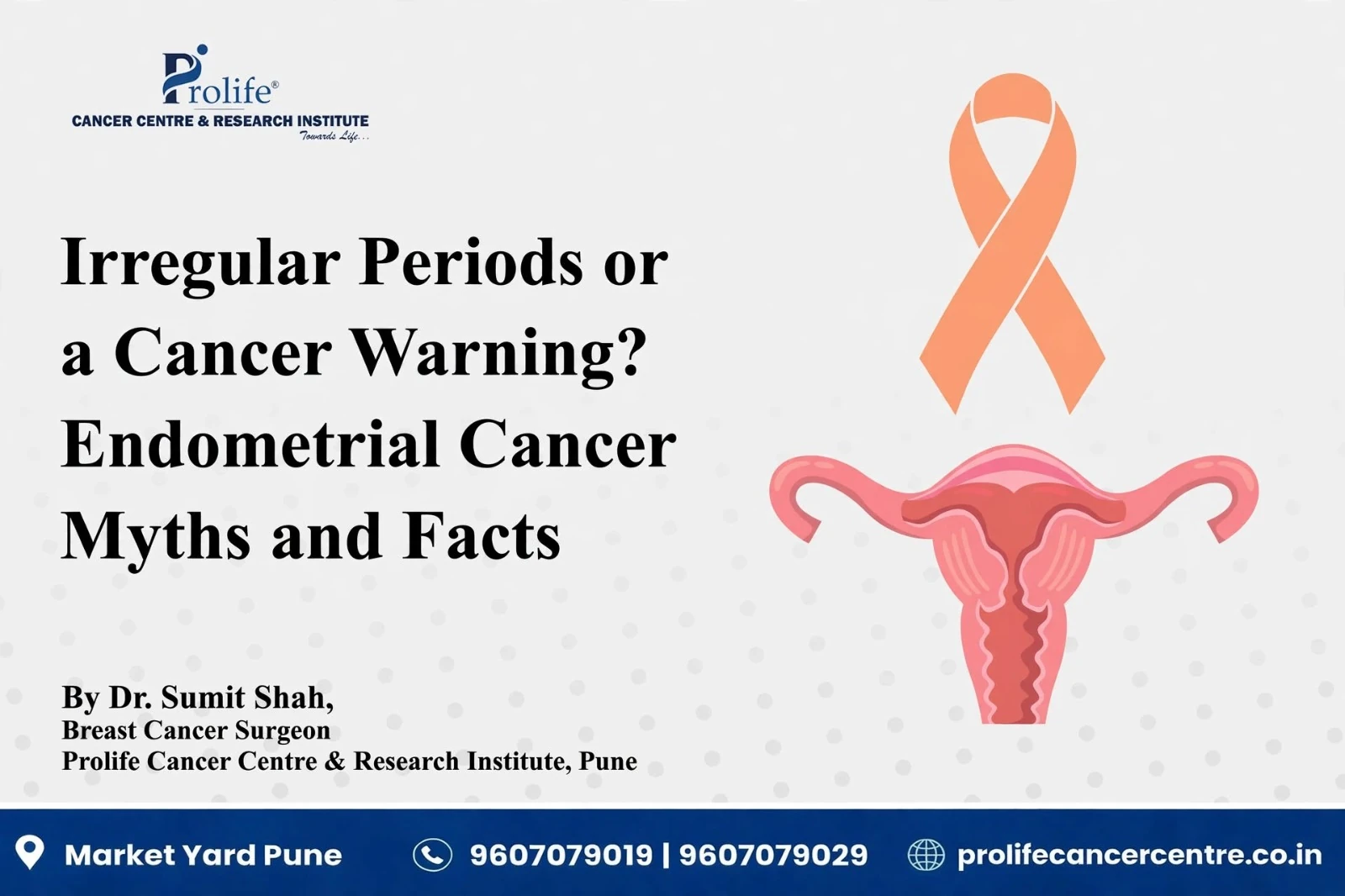
Irregular Periods or a Cancer Warning? Endometrial Cancer Myths and Facts
By Dr Sumit Shah, Robotic Cancer Surgeon in Pune
Prolife Cancer Centre & Research Institute, Pune
The patient example below is fictional and intended for awareness.
“I thought my periods had started again. There was hardly any bleeding!”
Meena, 52, had noticed spotting after 15 months without periods. With no pain or discomfort, she assumed it was a normal hormonal change. When the spotting returned, her daughter encouraged her to seek medical advice.
An evaluation, including ultrasound and an endometrial biopsy, revealed early-stage endometrial cancer.
Her story highlights an important message: bleeding after menopause needs assessment, even if it happens only once. Most causes are not cancer, but timely evaluation can help identify uterine cancer symptoms early. (acog.org)
What Is Endometrial Cancer?
Endometrial cancer develops in the inner lining of the uterus. It is a type of uterine cancer, different from cervical cancer, which affects the cervix.
Understanding the connection between the menstrual cycle and endometrial cancer helps women recognise changes without unnecessary fear.
Myth 1: “Heavy Periods Always Mean Uterine Cancer”
Fact: Heavy menstrual bleeding commonly results from fibroids, polyps, or hormonal changes.
However, persistent heavy periods, bleeding between periods, or a new bleeding pattern require assessment. These can sometimes be early symptoms of endometrial cancer. Consult a gynaecologist rather than assuming the cause or repeatedly treating the bleeding yourself. (acog.org)
Myth 2: “Spotting After Menopause Is Harmless”
Fact: Any vaginal bleeding after 12 consecutive months without periods due to menopause needs medical evaluation.
Postmenopausal bleeding may appear as a few drops, pink discharge, or brown spotting. Neither the amount of bleeding nor the absence of pain can rule out cancer. (acog.org)
Myth 3: “PCOS and Irregular Periods Have No Connection With Cancer”
Fact: PCOS with prolonged infrequent ovulation can expose the uterine lining to oestrogen without sufficient progesterone. This can increase the risk of endometrial thickening and cancer.
Obesity and certain inherited conditions also increase risk. However, PCOS does not mean you will develop endometrial cancer. Regular medical care helps address prolonged gaps between periods. (acog.org)
Myth 4: “Only Older Women Get Endometrial Cancer”
Fact: Although more common after menopause, endometrial cancer can affect younger women. Persistent abnormal bleeding deserves attention at any age.
Early menstruation and late menopause are additional risk factors, but neither means cancer is inevitable. Your symptoms, medical history, and individual risk guide further investigation. (acog.org, cancer.gov)
Myth 5: “A Normal Pap Smear Rules Out Uterine Cancer”
Fact: A Pap smear checks for cervical abnormalities; it does not reliably exclude endometrial cancer.
For endometrial cancer diagnosis, doctors may recommend ultrasound and an endometrial biopsy. A tissue sample is needed to confirm cancer. (cancer.gov)
Endometrial Cancer Treatment in Pune: What Happens Next?
Uterine cancer treatment depends on the cancer’s stage, type, and the patient’s health. Surgery is commonly the main treatment; additional treatment is recommended when needed. (cancer.gov)
If you are seeking an endometrial cancer specialist in Pune, bring your ultrasound and biopsy reports for a detailed discussion. Questions about robotic surgery for uterine cancer should include whether the approach suits your diagnosis.
For personalised guidance on endometrial cancer treatment in Pune, consult Dr. Sumit Shah, Robotic Cancer Surgeon, Prolife Cancer Centre & Research Institute, Pune.
Notice the change. Find the cause. Do not postpone your consultation.
